



From the CCCB Standing Committee for Family and Life:
On June 17, 2026, a decade will have passed since Bill C-14 received Royal Assent, legalizing euthanasia and assisted suicide across Canada, and permitting eligible adults, under specified conditions, to access what is legally termed “Medical Assistance in Dying” (“MAID”).
As we mark this sobering anniversary, the Canadian Conference of Catholic Bishops’ (CCCB) Standing Committee for Family and Life invites the Catholic faithful and all people of goodwill to voice renewed concern about “MAID,” to remain steadfast in opposing euthanasia and assisted suicide, to pray for the conversion of hearts and minds away from this practice, and to be present to persons who are sick and vulnerable.
Canada now has “the world’s largest and fastest-growing euthanasia program.”1 The percentage of “MAID” deaths is increasing annually and accounts for 5.1% of all deaths in 2024 (or 16,499 Canadians).2 Since its legalization, an estimated 100,000 Canadians have died by euthanasia or assisted suicide.3 Grave concern is warranted regarding the continued expansion of the eligibility criteria for “MAID,” which puts increasing numbers of Canadians at risk. In 2016, only individuals whose death was “reasonably foreseeable” were eligible for “MAID” with so-called “safeguards” in place. Subsequent legislation in 2021, however, considerably broadened the criteria, expanding access to include those whose death is not reasonably foreseeable, but whose condition is “grievous and irremediable.”4
On this occasion, we reject complacency with the status quo on euthanasia in Canada. Formed by the Gospel, we are called to draw near to those who suffer: not to ignore, trivialize, or abandon them in their pain or despair, but to accompany them with compassion, practical care, and hope (cf. Lk 10:30- 37). We actively seek opportunities for effective, collaborative strategies to provide concrete and compassionate support to those living with serious physical or mental illness, those with disabilities, and those nearing the end of life, as well as their families and caregivers. As disciples of Christ, we affirm that every human life is a gift, holds profound dignity and value and is part of a human community (cf. Mt 25:31-46).
—
We are invited to write Premier Tim Houston and our local MLAs to express our opposition to MAiD and our support for palliative care.
Sample letter to Premier Tim Houston
We need to focus on advancing compassionate, life-affirming palliative care.
Frequently Asked Questions about Palliative Care
(Adapted from the Archdiocese of Toronto)
What is palliative care?
Palliative care is the Catholic response to end-of-life care. It affirms that every human life is sacred despite any illness. It is compassionate both towards individuals and their families.
Why choose palliative care?
Palliative care affirms the intrinsic value of every life, given to us by God. It neither seeks to hasten nor postpone death. It manages pain, helping individuals navigate their symptoms while in treatment or helps alleviate physical pain until natural death.
Who provides palliative care?
Palliative care usually involves more than one person because it recognises the integrity and sacredness of the whole person – their physical, psychological, social, spiritual, and religious needs. A team approach in palliative care includes coordinating clinical care expertise and practical supports between professionals, families, volunteers and the wider community. A single medical practitioner cannot fulfil all these roles.
When should one consider palliative care?
Palliative care is flexible. It can be used during the earlier stages of an illness, with treatments aimed at a cure, or at end of life when a cure is not possible.
Where does one receive palliative care?
Adults and children can receive palliative care at the hospital, at home, in long-term care homes and hospices, such as Hospice Cape Breton in Sydney.
Is palliative care different from hospice?
While the terms palliative and hospice care are often used interchangeably, they are different. Palliative care is available at any stage of an illness whereas hospice care is only available at the end of life when a cure is not possible and treatment is discontinued.
—
Pastoral Letter On the Expansion of MAiD
March 2026
My Dear Clergy and my Dear Brothers and Sisters in Christ,
 As your bishop, I feel called to address an urgent and important issue that impacts the very dignity of human life and the moral fabric of our society: the expansion of Medical Assistance in Dying, MAiD. Recent developments, including legislation that will soon permit MAiD for individuals whose sole condition is mental illness, pose profound moral and spiritual questions that we must reflect upon as a community of faith.
While some may question it, the Catholic Church firmly teaches that MAiD is gravely contrary to the dignity of the human person. This teaching is rooted in Scripture, Tradition, natural law, the Catechism, papal encyclicals, and the magisterial documents of the Congregation for the Doctrine of the Faith. As the Catechism states, “Human life must be respected and protected absolutely. From the first moment of conception until death.” (CCC 2270)
The Church’s position is also supported by the encyclical Samaritanus bonus, which warns that legislation placing MAiD under the guise of palliative care creates “grave cultural confusion” and risks vulnerable individuals being led to choose death due to despair, loneliness, or being perceived as a burden to family. Instead, the Church advocates for palliative and hospice care—approaches that never abandon the sick or vulnerable but instead accompany them with compassion, spiritual support, and appropriate medical treatment. Dignitas Infinita also firmly condemns euthanasia as a grave violation of human dignity while promoting palliative care as the appropriate response to human suffering.
What began as a safeguard for terminally ill patients has expanded beyond its original scope. Today, MAiD is accessible to those who are not dying, including individuals with disabilities and chronic conditions. Now, legislation is poised to permit MAiD for those whose only medical condition is mental illness, effective March 17, 2027.
This expansion raises serious moral concerns. It suggests that life with mental health challenges—conditions which are often treatable and where recovery is possible—can be deemed less valuable or unworthy of life. Such a view contradicts our Catholic understanding that all human life, created in the image and likeness of God, is sacred and worthy of respect, regardless of age, health, or mental state.
Jesus Christ exemplifies the true response to human suffering. He never turned away from the sick and the suffering. Instead, He touched the lepers, comforted the lonely, and walked alongside those in pain. His life teaches us that the answer to suffering is love, not death. Through palliative care, we can relieve pain and nurture the whole person—body, mind, and spirit—honouring the dignity of each individual.
Offering MAiD as a quick solution to despair or loneliness risks undermining the inherent worth of every human being. Feelings of hopelessness are real, but they require compassion, not an end to life. The Church teaches that to intentionally end a human life is intrinsically evil, as it contradicts the fundamental truth that life is a gift from God, deserving of protection at every stage.
As Christians, we are called to witness hope and compassion. We must advocate for a culture that affirms life and the dignity of every person, especially those most vulnerable to being discarded or overlooked.
In Nova Scotia, vulnerable patients are already being offered MAiD, sometimes even before they ask for it. Doctors are required to participate or face disciplinary measures. As legislation advances, the risk is that mental health conditions could be used as a sole justification for requesting MAiD, despite the fact that mental illnesses are often treatable, and recovery is possible. We know there are serious gaps in mental health care support in our country. We also know that those who suffer from mental illness are among the most vulnerable. We are called to offer help, not harm, hope, not despair and protection, not abandonment.
A private members’ bill, Bill C-218, was introduced in the Canadian Parliament in December 2025. It comes up for a second reading in April 2026. Bill C-218 aims to amend the Criminal Code to permanently exclude mental illness as the sole medical condition justifying access to MAiD. If this legislation does not pass, then as of March 17, 2027, the law will take effect to allow MAiD for those whose sole underlying condition is mental illness.
In Alberta, in March 2026, the Safeguards for Last Resort Termination of Life Act, Bill 18, was introduced to prohibit MAiD solely based on mental illness. We pray that Nova Scotia may follow suit and enact similar protections.
We urge all parish communities to stand in defence of human life. The Third Sunday of Easter, April 18/19, will be designated as MAiD Awareness Sunday or Dignity Sunday to raise awareness of the importance of protecting life at every stage and of opposing the expansion of MAiD to include mental health as the only qualifying condition.
We encourage parishes to share the provided informational materials, pray for those affected, and contact the Honourable Brian Comer, Provincial Minister of Mental Health and Addictions, as well as your local MP, to express your support for Bill C-218.
Every human life is sacred, and so we are called to support, accompany, and serve those who suffer—not to abandon them or hasten their death. Our response must be rooted in Christ’s love, offering hope where despair threatens to take hold.
May the Lord strengthen us in this mission, and may we continue to be witnesses of life, hope, and compassion.
Wishing you a blessed and joyful Easter filled with hope, love, and new life.
+ Wayne Joseph Kirkpatrick
Bishop Wayne Joseph Kirkpatrick
Bishop of Antigonish
—
Medical Assistance in Dying, or MAiD, is also known as euthanasia or assisted suicide.
As Christians, we are called to care for the vulnerable and uphold the dignity of every life. If no action is taken before March 17, 2027, Medical Assistance in Dying (MAiD) will be expanded to include individuals whose only medical condition is mental health-related. Suicidal thinking can be a symptom for those living with mental illness. When patients share their desire to die, it’s time to use suicide prevention strategies.
However, the NS medical regulator requires physicians to offer euthanasia to patients as one of their potential medical treatments without patients requesting that information and, if the patient requests it, sign referral forms so their patients can get euthanasia. Imagine the dilemma of the Christian physician who is forced to help the patient access euthanasia rather than treating them.
We invite parishioners to write to the Honourable Brian Comer, Minister of Mental Health and Addictions, to ask for stronger protections, improved mental health supports, and changes to physician legal requirements.
—
CCCB Statement on Bill C-218: No “MAiD” for Mental Illness
The Permanent Council of the Canadian Conference of Catholic Bishops (CCCB) has issued a statement strongly supporting Private Member’s Bill C-218, which seeks to prevent persons whose sole medical condition is mental illness from accessing euthanasia and physician-assisted suicide (“MAiD”).
The CCCB has a strong record of opposing “MAiD” and seeking to limit its scope in Canadian society. This statement has been approved by 14 Bishops from across Canada, who together form the Permanent Council, the CCCB’s most authoritative voice between Plenary Assembly meetings.
The statement’s position aligns with the Permanent Council’s 2023 Open Letter to the Government of Canada on Permitting Persons Living with Mental Illness to Access Euthanasia/Assisted Suicide: “To enable or assist in the suicide for these patients directly contradicts national suicide prevention strategies and reneges on our collective social responsibility to provide persons living with mental health challenges with treatment, support, and hope through therapeutic interventions.”
Referencing empirical research and the professional judgment of many mental health professionals, today’s statement notes that mental illness is not necessarily irremediable. This implies that access to treatment for mental illness, including palliative care, must be improved.
The Permanent Council concludes with an exhortation to allow parliamentarians to vote on Bill C‑218 according to their conscience rather than following party line.
Read the full statement:
In English: https://www.cccb.ca/wp-content/uploads/2026/02/2026-02-04-Statement-by-CCCB-PC-Support-of-Bill-C-218.pdf
In French: https://www.cecc.ca/wp-content/uploads/2026/02/2026-02-04-Declaration-du-CP-de-la-CECC-Appui-du-Projet-de-loi-C-218.pdf
—
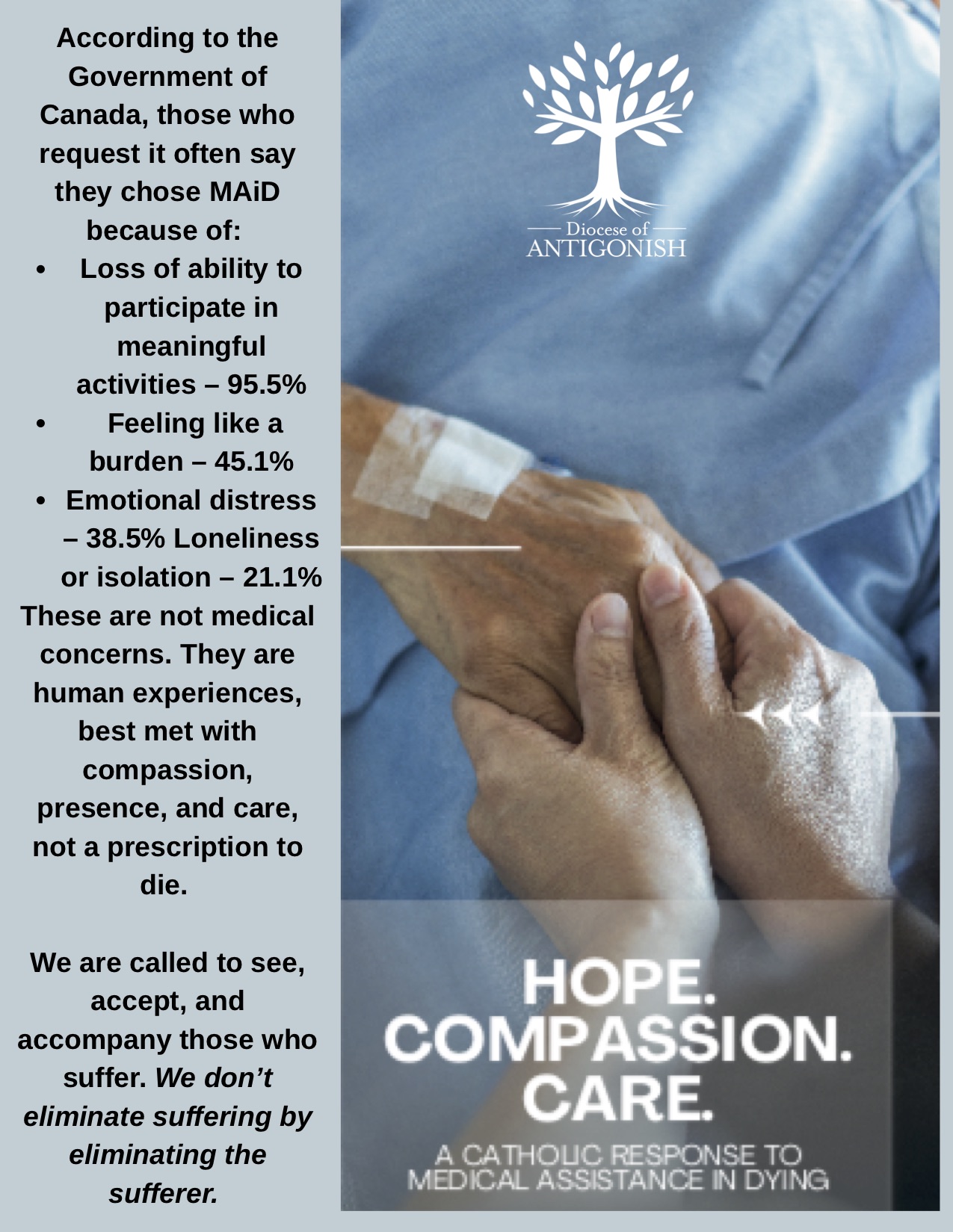
Brochures titled ‘A Catholic Response to Medical Assistance in Dying’ have been made available to our parishes, and are also available at our diocesan offices and can be downloaded here.
—
On Sunday, November 2, 2025 the Feast of All Souls, when we pray for those who have died and reflect on how we, as Christians, view death, it was considered an appropriate time also to highlight our opposition to MAiD. Bishop Kirkpatrick requested that every parish affirm that all life is sacred from conception to natural death and that Medical Assistance in Dying, also known as MAiD, is contrary to our Christian faith.
Read Bishop Kirkpatrick’s homily
Watch Bishop Kirkpatrick’s homily via the Nov. 2 livestream from St. Ninian’s Cathedral
To learn more about MAiD and our Catholic response:
