

The compassion of the Samaritan:
loving by bearing another’s pain
Message of Pope Leo XIV:
Dear brothers and sisters,
The thirty-fourth World Day of the Sick will be solemnly celebrated in Chiclayo, Peru, on 11 February 2026. For this occasion, I would recommend reflecting once again on the figure of the Good Samaritan, for he is always relevant and essential for rediscovering the beauty of charity and the social dimension of compassion. This reflection further directs our attention towards the needy and all those who suffer, especially the sick.
We are all familiar with the moving account found in the Gospel of Saint Luke (cf. Lk 10:25-37). Jesus responds to a scholar of the law, who asks him to identify the neighbor he must love, with this story: a man traveling from Jerusalem to Jericho was attacked by robbers and left for dead. While a priest and a Levite passed him by, a Samaritan took pity on him, bandaged his wounds, took him to an inn and provided for his care. I have chosen to reflect on this biblical passage through the lens of the Encyclical Fratelli Tutti, written bymy beloved predecessor Pope Francis. There, compassion and mercy towards those in need are not reduced to a merely individual effort, but are realized through relationships: with our brothers and sisters in need, with those who care for them and, ultimately, with God who gives us his love.
1. The gift of encounter: the joy of offering closeness and presence
We live immersed in a culture of speed, immediacy and haste – a culture of “discard” and indifference that prevents us from pausing along the way and drawing near to acknowledge the needs and suffering that surround us. In the parable, when the Samaritan saw the wounded man, he did not “pass by.” Instead, he looked upon him with an open and attentive gaze – the very gaze of Jesus – which led him to act with human and compassionate closeness. The Samaritan “stopped, approached the man and cared for him personally, even spending his own money to provide for his needs… [Above all] he gave him his time.” [1] Jesus does not merely teach us who our neighbor is, but rather how to become a neighbor; in other words, how we can draw close to others. [2] In this respect, we can affirm with Saint Augustine that the Lord did not intend to show us who that man’s neighbor was, but rather to whom he should become a neighbor. Indeed, no one is truly a neighbor until they freely draw near to another. Thus, the one who became a neighbor was the one who showed mercy. [3]
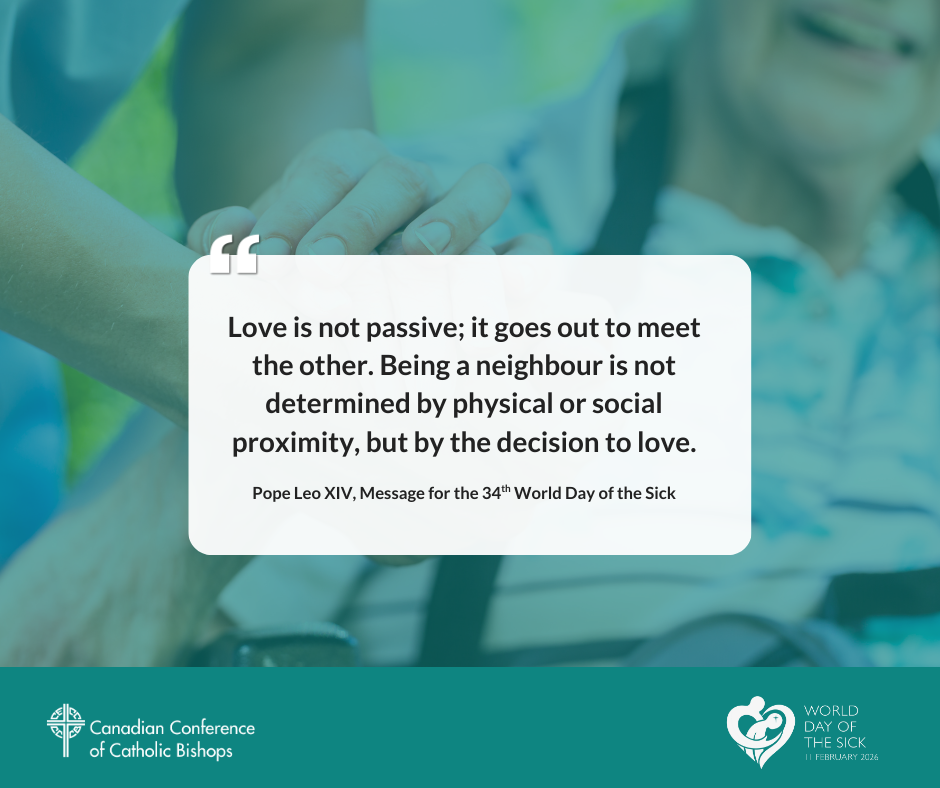 Love is not passive; it goes out to meet the other. Being a neighbor is not determined by physical or social proximity, but by the decision to love. This is why Christians become neighbors to those who suffer, following the example of Christ, the true divine Samaritan who drew near to a wounded humanity. These are not mere gestures of philanthropy, but signs through which we perceive that personal participation in another’s suffering involves the gift of oneself. It means going beyond the simple satisfaction of needs, so that our very person becomes part of the gift. [4] This kind of charity is necessarily nourished by an encounter with Christ, who gave himself for us out of love. Saint Francis expressed this beautifully when, speaking of his encounter with lepers, he said: “The Lord himself led me among them,” [5] because through them he had discovered the sweet joy of loving.
The gift of encounter flows from our union with Jesus Christ. We recognize him as the Good Samaritan who has brought us eternal salvation, and we make him present whenever we reach out to a wounded brother or sister. Saint Ambrose said: “Since no one is more truly our neighbor than he who has healed our wounds, let us love him as Lord and also as neighbor; for nothing is so close as the head to its members. Let us also love those who imitate Christ; let us love those who suffer due to the poverty of others, for the sake of the unity of the Body.” [6] “To be one in the One” – through closeness, presence, and love received and shared – is to rejoice, like Saint Francis, in the sweetness of having encountered the Lord.